Prépositions devant les pays et les villes - Prepositions with countries and cities (Level A1)
🎯 quiz included
Prépositions devant les pays et les villes
Prepositions with countries and cities
1. La règle
On utilise des prépositions différentes selon le type de lieu.
- à + ville
- en / au / aux + pays
Ville → à
Pays féminin → en
Pays masculin → au
Pays pluriel → aux
In French, the preposition changes depending on whether it is a city or a country, and on the gender of the country.
2. Tableau clair
| Type de lieu | Préposition | Exemple | Traduction |
|---|---|---|---|
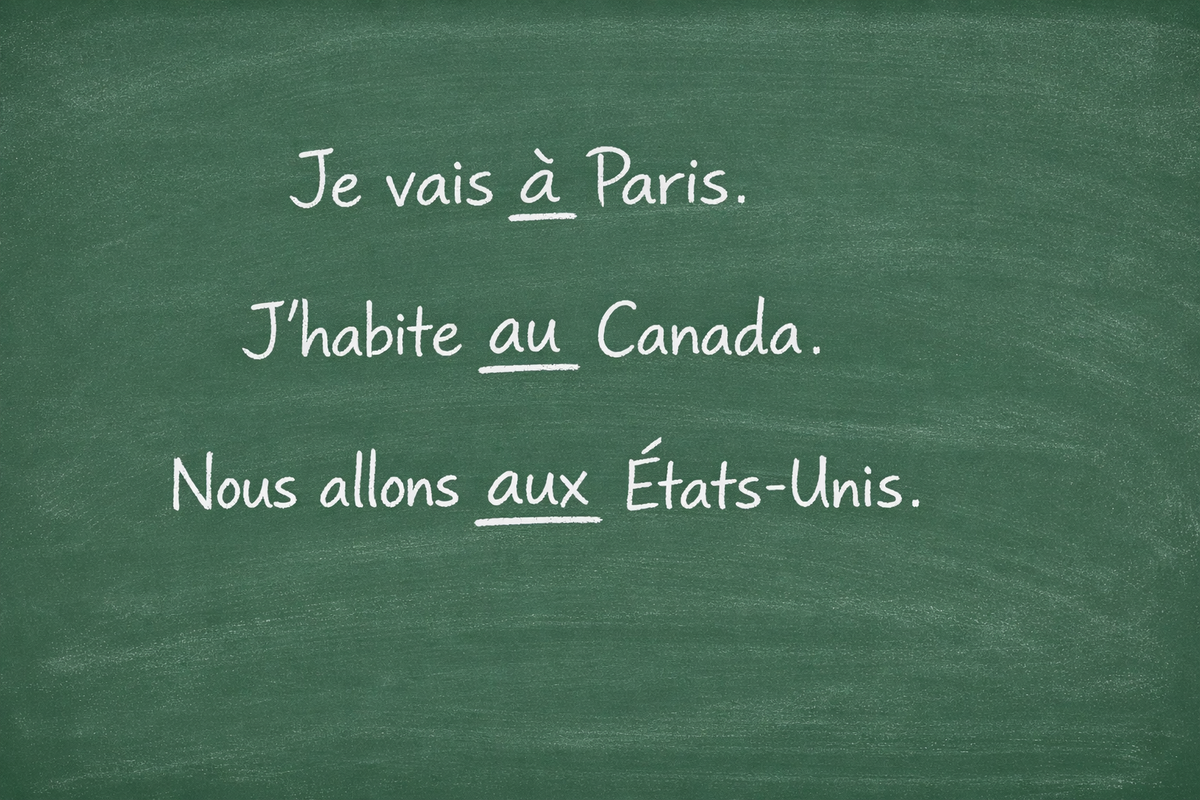
| Ville | à | Je vais à Paris. | I’m going to Paris. |
| Ville | à | J’habite à Montréal. | I live in Montreal. |
| Pays féminin | en | Je voyage en France. | I travel to France. |
| Pays féminin | en | Elle travaille en Italie. | She works in Italy. |
| Pays masculin | au | Il habite au Canada. | He lives in Canada. |
| Pays masculin | au | Nous allons au Japon. | We are going to Japan. |
| Pays pluriel | aux | Je vais aux États-Unis. | I’m going to the United States. |
| Pays pluriel | aux | Ils vivent aux Pays-Bas. | They live in the Netherlands. |
3. Exemples utiles
Je vais à Londres.
I’m going to London.
Nous habitons en Espagne.
We live in Spain.
Il travaille au Mexique.
He works in Mexico.
Elles vont aux États-Unis.
They are going to the United States.
Tu habites à Toronto.
You live in Toronto.
Astuce pour anglophones
En anglais, on utilise souvent to ou in pour tous les lieux. En français, il faut choisir la préposition correcte.
Erreur fréquente :
❌ Je vais à Canada.
✅ Je vais au Canada.
❌ J’habite en Montréal.
✅ J’habite à Montréal.
If you do not know whether the country is masculine or feminine, you cannot choose the correct preposition.
4. Quiz
Choisissez la bonne réponse : à / en / au / aux