Les verbes pronominaux au présent - Reflexive verbs in the present tense (Level A1)
🎯 quiz included
🔁
Les verbes pronominaux au présent
Level A1Reflexive verbs in the present tense — rule, conjugation tables, and practice quiz.
1️⃣ Règle (Rule)
Les verbes pronominaux se conjuguent avec un pronom réfléchi qui va avec le sujet.
Reflexive verbs are conjugated with a reflexive pronoun that matches the subject.
Ils décrivent souvent des actions quotidiennes que le sujet fait sur lui-même.
They often describe daily actions that the subject does to themselves.
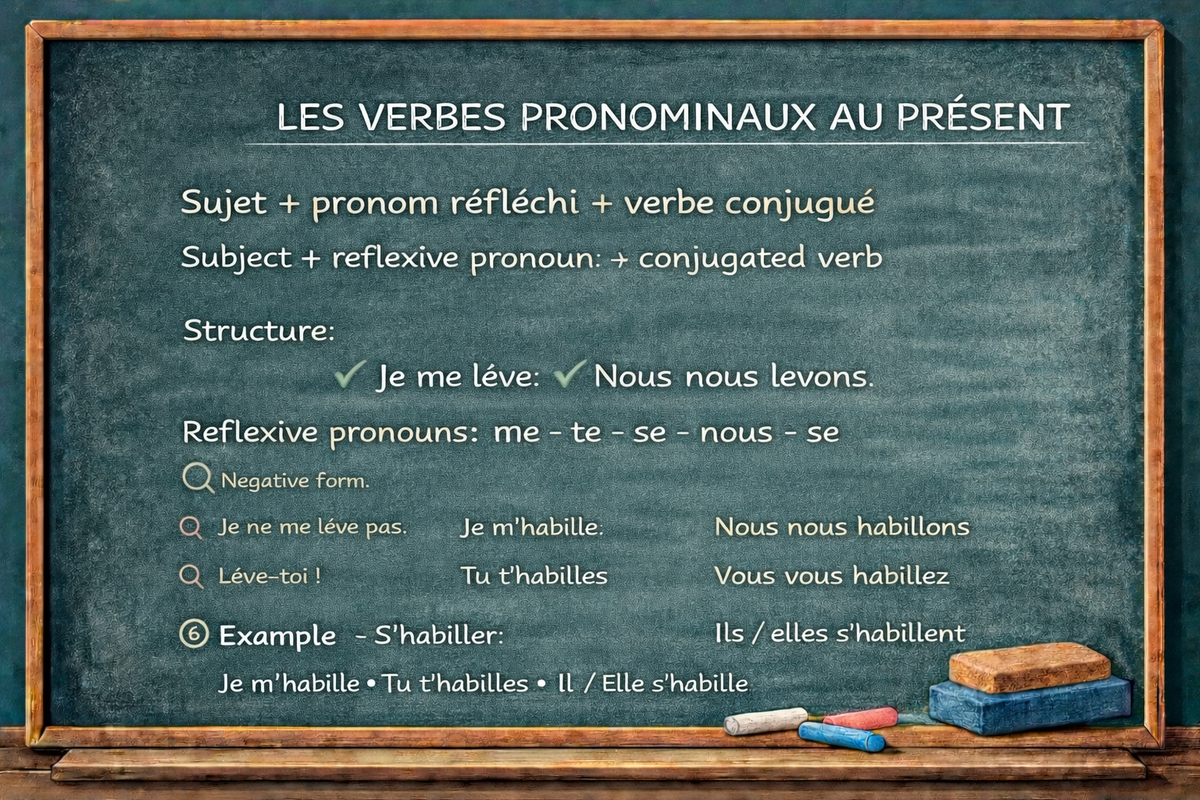
Structure :
Sujet + pronom réfléchi + verbe conjugué
Subject + reflexive pronoun + conjugated verb
Exemple :
Je me lève. — I get up.
⚠️ Le pronom réfléchi change selon le sujet :
• me (myself)
• te (yourself — informal singular)
• se (himself / herself / itself)
• nous (ourselves)
• vous (yourself — formal singular / yourselves)
• se (themselves)
⚠️ À la forme négative, le pronom reste avant le verbe.
In the negative form, the pronoun stays before the verb.
Je ne me lève pas. — I do not get up.
⚠️ À l’impératif affirmatif, le pronom se place après le verbe.
In the affirmative imperative, the pronoun comes after the verb.
Lève-toi ! — Get up!
Reflexive verbs are conjugated with a reflexive pronoun that matches the subject.
Ils décrivent souvent des actions quotidiennes que le sujet fait sur lui-même.
They often describe daily actions that the subject does to themselves.
Structure :
Sujet + pronom réfléchi + verbe conjugué
Subject + reflexive pronoun + conjugated verb
Exemple :
Je me lève. — I get up.
⚠️ Le pronom réfléchi change selon le sujet :
• me (myself)
• te (yourself — informal singular)
• se (himself / herself / itself)
• nous (ourselves)
• vous (yourself — formal singular / yourselves)
• se (themselves)
⚠️ À la forme négative, le pronom reste avant le verbe.
In the negative form, the pronoun stays before the verb.
Je ne me lève pas. — I do not get up.
⚠️ À l’impératif affirmatif, le pronom se place après le verbe.
In the affirmative imperative, the pronoun comes after the verb.
Lève-toi ! — Get up!
2️⃣ Tableau de conjugaison – Se lever (Conjugation table – To get up)
| Sujet | Pronom réfléchi | Verbe | Traduction |
|---|---|---|---|
| Je | me | lève | I get up |
| Tu | te | lèves | You get up (informal) |
| Il / Elle / On | se | lève | He / She / One gets up |
| Nous | nous | levons | We get up |
| Vous | vous | levez | You get up (formal/plural) |
| Ils / Elles | se | lèvent | They get up |
3️⃣ Exemple avec un autre verbe – S’habiller (Example – To get dressed)
| Sujet | Forme complète | Traduction |
|---|---|---|
| Je | je m’habille | I get dressed |
| Tu | tu t’habilles | You get dressed |
| Il / Elle / On | il / elle s’habille | He / She gets dressed |
| Nous | nous nous habillons | We get dressed |
| Vous | vous vous habillez | You get dressed |
| Ils / Elles | ils / elles s’habillent | They get dressed |
💡 Devant une voyelle ou un “h” muet : me → m’, te → t’, se → s’.