Le pronom Y - The pronoun Y (Level A1)
🎯 Quiz included
Le pronom Y
The pronoun Y
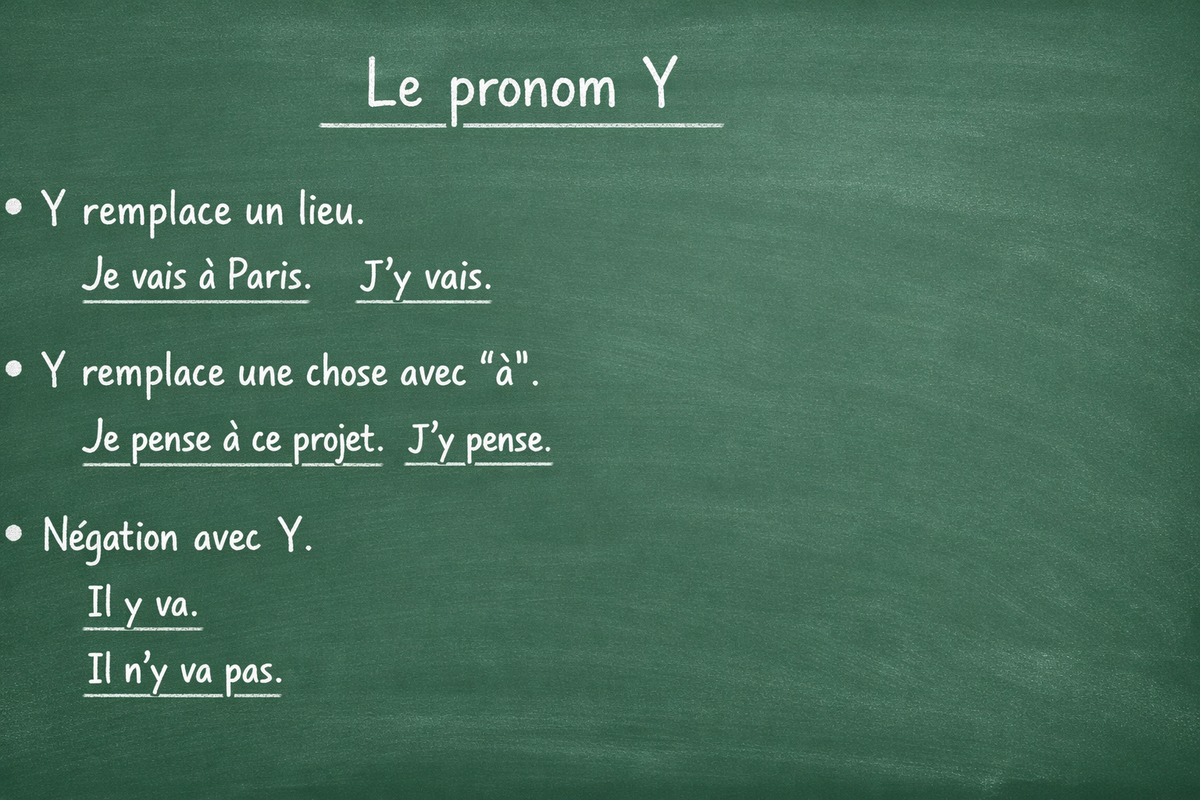
Le pronom Y remplace souvent un lieu ou une chose introduite par “à”.
The pronoun Y often replaces a place or a thing introduced by “à”.
1. La règle générale
Le pronom Y remplace le plus souvent un complément de lieu ou un complément introduit par la préposition « à ».
The pronoun Y usually replaces a place complement or a complement introduced by the preposition “à”.
Il permet d’éviter la répétition dans la phrase.
It helps avoid repetition in a sentence.
Le pronom Y se place avant le verbe conjugué.
The pronoun Y is placed before the conjugated verb.
Avec un verbe à l’infinitif, Y se place avant l’infinitif.
With an infinitive verb, Y is placed before the infinitive.
Je vais y aller.
I am going to go there.
2. Y remplace un complément de lieu
Y replaces a place complement.
| Phrase avec le lieu | Phrase avec Y |
|---|---|
| Paul va à Lyon. Paul goes to Lyon. |
Il y va. He goes there. |
| Anne habite à Lisbonne. Anne lives in Lisbon. |
Elle y habite depuis un an. She has lived there for a year. |
| Jean est sur les Champs-Élysées. Jean is on the Champs-Élysées. |
Il y est depuis midi. He has been there since noon. |
| Je suis chez moi. I am at home. |
J’y suis jusqu’à six heures. I am there until six o’clock. |
3. Y remplace une chose, jamais une personne, introduite par “à”
Y replaces a thing, never a person, introduced by the preposition “à”.
| Phrase complète | Phrase avec Y |
|---|---|
| Je pense à mon pays. I think about my country. |
J’y pense souvent. I think about it often. |
| Je participe à ce projet. I participate in this project. |
J’y participe. I participate in it. |
| Je réfléchis à sa proposition. I think about his proposal. |
J’y réfléchis. I think about it. |
4. La négation avec Y
La négation se place avant et après le bloc pronom + verbe.
Negation is placed before and after the block pronoun + verb.
| Phrase affirmative | Phrase négative |
|---|---|
| Il y va. He goes there. |
Il n’y va pas. He does not go there. |
| J’y pense. I think about it. |
Je n’y pense pas. I do not think about it. |
| Il y en a plus. There are more of them. |
Il n’y en a plus. There are no more. |
5. Expressions courantes avec Y
| Expression | Traduction |
|---|---|
| Paul est un connaisseur en vin : il s’y connaît. | Paul is a wine expert: he knows about it. |
| Je ne suis pas responsable : je n’y suis pour rien. | I am not responsible: it has nothing to do with me. |
| Venez me voir demain ! — Je n’y manquerai pas ! | Come see me tomorrow! — I will not fail to do so! |
| Voilà, ça y est, c’est fini ! | That’s it, it’s finished! |
6. Astuce pour anglophones
En anglais, on dit souvent “there” ou “about it”, mais en français on utilise très souvent Y.
In English, we often say “there” or “about it”, but in French we often use Y.
Je pense à ce problème souvent.
J’y pense souvent.
7. Quiz : Le pronom Y
Choisissez la bonne traduction en français.