La météo en français - The weather
🎯 Quiz included
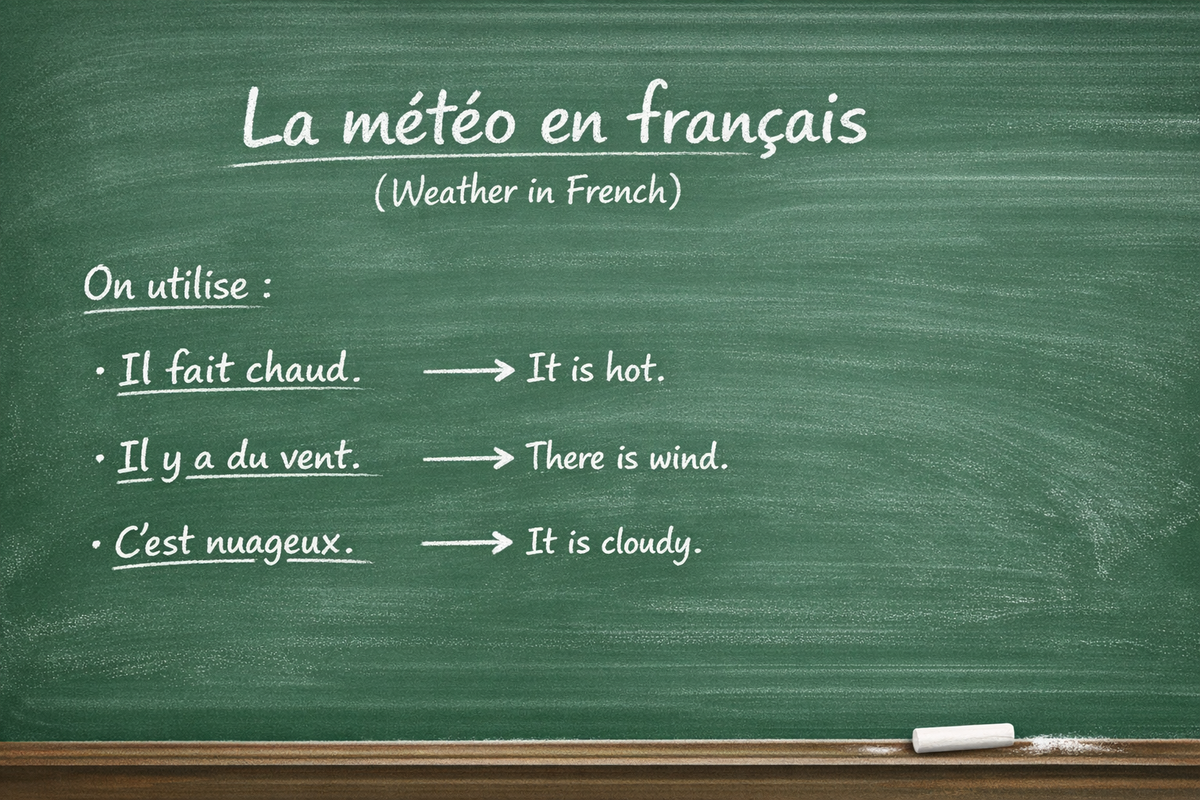
La météo en français (Weather in French)
La règle
En français, on utilise souvent la structure « il fait »,
« il y a » ou un adjectif avec « c’est / le temps est »
pour parler de la météo.
In French, we often use the structures “il fait”, “il y a”, or an adjective with “c’est / the weather is” to talk about the weather.
Ces expressions sont impersonnelles : le pronom il ne représente personne.
These expressions are impersonal: the pronoun “il” does not refer to a person.
1. Les expressions avec IL FAIT
Expressions with IL FAIT
On utilise il fait pour parler de la température ou d’une sensation climatique.
We use “il fait” to talk about temperature or a weather condition.
| Français | Traduction |
|---|---|
| Il fait chaud. | It is hot. |
| Il fait froid. | It is cold. |
| Il fait frais. | It is cool. |
| Il fait beau. | The weather is nice. |
| Il fait mauvais. | The weather is bad. |
| Il fait gris. | It is grey. |
| Il fait humide. | It is humid. |
2. Les expressions avec IL Y A
Expressions with IL Y A
On utilise il y a pour parler de la présence d’un phénomène météorologique.
We use “il y a” to talk about the presence of a weather phenomenon.
| Français | Traduction |
|---|---|
| Il y a du vent. | There is wind. |
| Il y a du soleil. | There is sunshine. |
| Il y a des nuages. | There are clouds. |
| Il y a du brouillard. | There is fog. |
| Il y a de l’orage. | There is a storm. |
3. Les adjectifs pour décrire le ciel
Adjectives to describe the sky
On peut aussi utiliser un adjectif pour décrire la météo.
We can also use an adjective to describe the weather.
| Français | Traduction |
|---|---|
| C’est nuageux. | It is cloudy. |
| Le temps est ensoleillé. | The weather is sunny. |
| Le temps est couvert. | The weather is overcast. |
| Le ciel est clair. | The sky is clear. |
| Le ciel est gris. | The sky is grey. |
4. Les saisons et la météo
Seasons and weather
| Saison | Météo typique |
|---|---|
| En hiver | Il fait froid. In winter, it is cold. |
| Au printemps | Il y a souvent du vent et de la pluie. In spring, there is often wind and rain. |
| En été | Il fait chaud et il y a du soleil. In summer, it is hot and there is sunshine. |
| En automne | Il y a des nuages et il fait frais. In autumn, there are clouds and it is cool. |
Astuce pour les anglophones
En anglais, on dit souvent “It is + adjective” pour parler du temps.
In English, we often say “It is + adjective” to talk about the weather.
Mais en français, on utilise souvent « il fait » pour la température.
Erreur fréquente :
❌ Il est chaud aujourd’hui.
✅ Il fait chaud aujourd’hui.
Résumé
| Structure | Exemple | Traduction |
|---|---|---|
| Il fait + adjectif | Il fait chaud. | It is hot. |
| Il y a + nom | Il y a du vent. | There is wind. |
| C’est / le temps est + adjectif | C’est nuageux. | It is cloudy. |
Quiz : La météo et les saisons
Quiz: Weather and seasons
Choisissez la bonne réponse.
Choose the correct answer.