Dire l’heure en français : formel vs informel - Telling time in French: formal vs informal (Level A1)
🎯 quiz included
🕒
Dire l’heure en français : formel vs informel
Level A1Telling time in French: formal (24-hour clock) vs informal (12-hour clock) + practice quiz.
1️⃣ RÈGLE GÉNÉRALE (General rule)
En français, on peut dire l’heure de deux façons :
In French, you can tell the time in two ways:
1. La manière formelle (horaire officiel, train, télévision, administration).
The formal way (official schedules, trains, TV, administration).
2. La manière informelle (dans la conversation quotidienne).
The informal way (in everyday conversation).
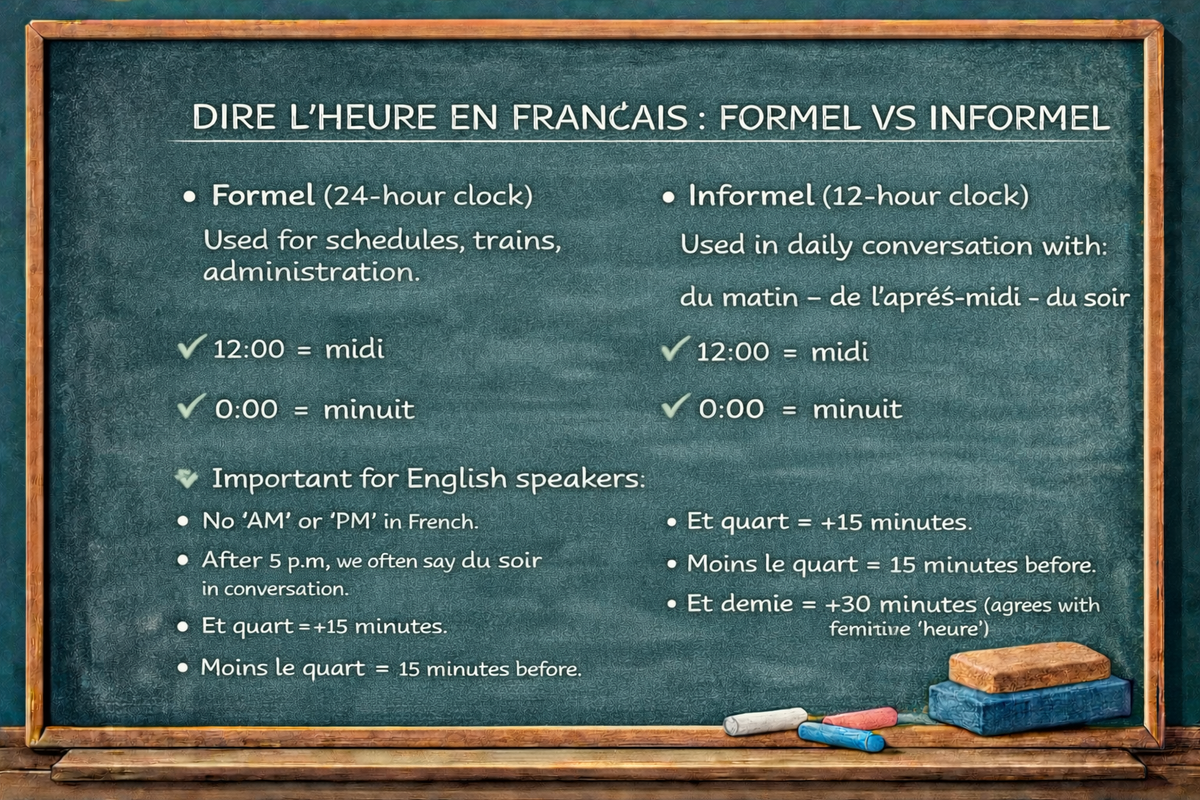
➤ La manière formelle utilise le système de 24 heures.
The formal way uses the 24-hour clock.
➤ La manière informelle utilise le système de 12 heures avec :
The informal way uses the 12-hour clock with:
• du matin (in the morning)
• de l’après-midi (in the afternoon)
• du soir (in the evening)
Attention :
• On dit midi pour 12:00. (We say “midi” for 12:00.)
• On dit minuit pour 0:00. (We say “minuit” for 12:00 a.m.)
In French, you can tell the time in two ways:
1. La manière formelle (horaire officiel, train, télévision, administration).
The formal way (official schedules, trains, TV, administration).
2. La manière informelle (dans la conversation quotidienne).
The informal way (in everyday conversation).
➤ La manière formelle utilise le système de 24 heures.
The formal way uses the 24-hour clock.
➤ La manière informelle utilise le système de 12 heures avec :
The informal way uses the 12-hour clock with:
• du matin (in the morning)
• de l’après-midi (in the afternoon)
• du soir (in the evening)
Attention :
• On dit midi pour 12:00. (We say “midi” for 12:00.)
• On dit minuit pour 0:00. (We say “minuit” for 12:00 a.m.)
Source du tableau : L'heure
🕒 Heures et minutes (Hours and minutes)
| Heure | Manière formelle | Formal way | Manière informelle | Informal way |
|---|---|---|---|---|
| 10:15 | dix heures quinze | ten fifteen | dix heures et quart | quarter past ten |
| 12:30 | douze heures trente | twelve thirty | midi et demie | half past noon |
| 14:35 | quatorze heures trente-cinq | fourteen thirty-five | trois heures moins vingt-cinq | twenty-five to three |
| 16:40 | seize heures quarante | sixteen forty | cinq heures moins vingt | twenty to five |
| 18:45 | dix-huit heures quarante-cinq | eighteen forty-five | sept heures moins le quart | quarter to seven |
| 20:50 | vingt heures cinquante | twenty fifty | neuf heures moins dix | ten to nine |
| 22:55 | vingt-deux heures cinquante-cinq | twenty-two fifty-five | onze heures moins cinq | five to eleven |
🕐 Heures complètes (Full hours)
| Heure | Manière formelle | Formal way | Manière informelle | Informal way |
|---|---|---|---|---|
| 8:00 | huit heures | eight o’clock | huit heures du matin | eight in the morning |
| 12:00 | douze heures | twelve o’clock | midi | noon |
| 15:00 | quinze heures | fifteen hundred hours | trois heures de l’après-midi | three in the afternoon |
| 18:00 | dix-huit heures | eighteen hundred hours | six heures du soir | six in the evening |
| 21:00 | vingt et une heures | twenty-one hundred hours | neuf heures du soir | nine in the evening |
| 0:00 | zéro heure | zero hour | minuit | midnight |
🎯 Points importants pour les anglophones
• En français, on ne dit pas “AM” ou “PM”. (We do not say “AM” or “PM”.)
• Après 17h, en conversation, on dit souvent du soir. (After 5 p.m., we often say “in the evening”.)
• Moins le quart = 15 minutes avant. (“Quarter to” = 15 minutes before.)
• Et quart = +15 minutes. (“Quarter past” = +15 minutes.)
• Et demie = +30 minutes (accord avec heure féminine). (“Half past” = +30 minutes.)
• Après 17h, en conversation, on dit souvent du soir. (After 5 p.m., we often say “in the evening”.)
• Moins le quart = 15 minutes avant. (“Quarter to” = 15 minutes before.)
• Et quart = +15 minutes. (“Quarter past” = +15 minutes.)
• Et demie = +30 minutes (accord avec heure féminine). (“Half past” = +30 minutes.)